What Your Team Actually Wants from Language Training (And Why Most Programmes Miss the Mark)
Corporate language training programmes often focus on what businesses think employees need rather than what learners actually want from their development experience. This misalignment creates frustrated participants, disappointing results, and wasted training investments. Understanding what language learners genuinely value transforms programme design from theoretical curriculum delivery into engaging experiences that produce genuine capability development and sustained participation.
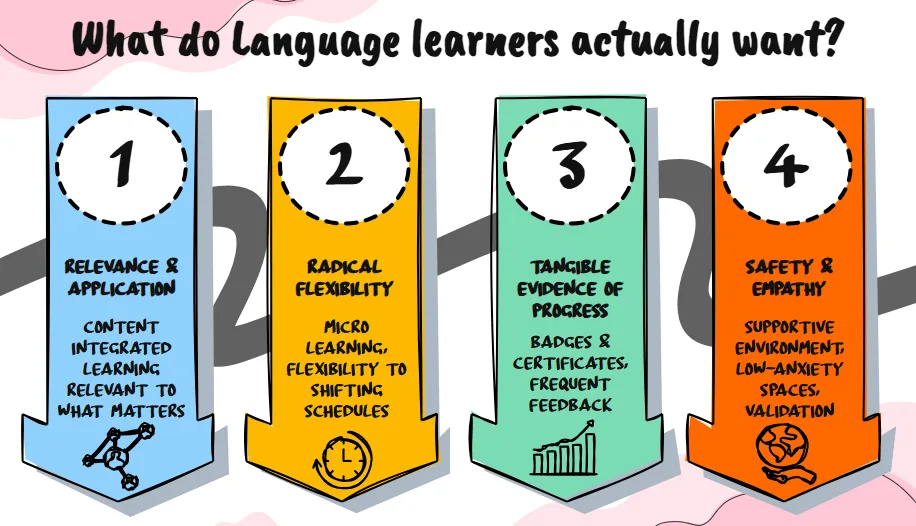
Relevance that connects to real work
Language learners consistently rank relevance as their top priority, yet many corporate training programmes deliver generic content disconnected from participants’ actual professional responsibilities. Employees learning Spanish don’t want tourist conversations about ordering tapas. They need vocabulary and scenarios directly applicable to their client meetings, presentations, and business negotiations.
This relevance requirement extends beyond simple vocabulary selection into scenario authenticity and context appropriateness. Sales professionals want practice conducting actual sales conversations. Customer service representatives need language for handling complaints and resolving issues. Operations teams require supplier communication capabilities rather than social chitchat skills.
Business language courses designed around genuine workplace applications maintain engagement through obvious utility. Participants recognise immediately how developing capabilities serve their professional effectiveness, creating motivation that abstract language study cannot generate regardless of instructional quality.
Content that matters to them personally
Integrated learning connecting language development to content participants care about professionally produces dramatically better engagement than pure language exercises divorced from meaningful context. Rather than practicing grammar through artificial exercises, learners want discussions addressing their actual work challenges, industry developments, or professional interests.
This content integration creates double value where language practice simultaneously builds communication capabilities and develops professional knowledge. Discussing market trends in German develops both language skills and business understanding. Practising presentation delivery in French improves both linguistic and professional presentation competencies.
Corporate training incorporating authentic business content transforms language learning from isolated skill building into comprehensive professional development that serves multiple objectives simultaneously. This efficiency appeals strongly to busy professionals who resist investing time in activities serving single narrow purposes.
Flexibility that respects their schedules
Modern professionals face packed schedules leaving limited time for additional commitments like language training. Learners want flexible options accommodating their variable availability rather than rigid programmes requiring perfect attendance regardless of business demands or personal circumstances.
This flexibility requirement doesn’t mean abandoning structure entirely. Rather, it involves offering multiple session times, providing recorded alternatives for occasional absences, and designing programmes allowing missed sessions without derailing overall progression. These accommodations demonstrate respect for participants’ time constraints whilst maintaining programme effectiveness.
Language classes designed for working professionals balance structure necessary for effective learning with flexibility acknowledging that business emergencies, travel requirements, and personal obligations occasionally conflict with training schedules. This balance prevents abandonment that rigid programmes often trigger.
Micro-learning that fits their attention spans
Extended training sessions fighting against modern attention span realities produce diminishing returns as concentration wanes and engagement drops. Learners increasingly prefer shorter, focused sessions delivering concentrated value rather than lengthy classes where attention drifts and effectiveness declines.
Micro-learning approaches delivering intensive practice in focused timeframes maintain engagement whilst producing better retention than longer sessions attempting to cover excessive material. Brief sessions also integrate more naturally into busy professional schedules, enabling consistent participation that longer commitments might prevent.
Professional development through concentrated sessions respects both cognitive science showing optimal learning periods and practical realities of modern professional life. This approach maximises learning efficiency whilst minimising schedule disruption that undermines programme sustainability.
Shifting schedules that adapt to changing needs
Business priorities shift constantly, creating unpredictable demands on professional time and attention. Learners want training programmes acknowledging this reality through accommodating schedule changes, offering makeup options, and demonstrating understanding when business emergencies require missing sessions.
Radical flexibility doesn’t mean chaotic disorganisation. Rather, it involves building programmes resilient to inevitable schedule disruptions whilst maintaining overall progression and learning effectiveness. This might include recorded session availability, peer catch-up systems, or instructor flexibility about individual progression variations.
Team learning environments that accommodate schedule flexibility whilst maintaining collective momentum create sustainable programmes serving long-term capability building rather than rigid structures that collapse when participants face inevitable conflicts.
Tangible progress that they can see
Language learners want concrete evidence of their developing capabilities rather than vague assurances about eventual fluency. Visible progress through achievable milestones, recognised improvements, and tangible capability demonstrations maintains motivation whilst providing satisfaction that abstract learning cannot deliver.
This progress visibility might include successfully conducting first client meeting in target language, delivering presentation that generates positive feedback, or handling customer inquiry independently without translation support. These authentic achievements prove capability development more convincingly than test scores or completion certificates.
Business language courses should structure learning around meaningful milestones demonstrating practical capability development. These tangible markers celebrate achievement whilst maintaining motivation through proving that time investment produces genuine professional value.
Badges and certificates that prove their achievement
Whilst intrinsic motivation matters most, learners also value external recognition validating their development efforts. Completion certificates, proficiency badges, and formal credentials provide tangible evidence of capability development that enhances CVs whilst demonstrating achievement to employers and colleagues.
These recognition elements serve practical purposes beyond motivation. They document capability development for performance reviews, support internal promotion discussions, and provide credentials valuable for career advancement. Professional development investments deserve formal recognition acknowledging participant commitment and achievement.
Corporate training programmes should include meaningful recognition systems that celebrate completion whilst providing credentials participants can reference professionally. These elements demonstrate that organisations value language development sufficiently to formally acknowledge achievement.
Frequent feedback showing improvement
Language learners need regular feedback about their progress, pronunciation accuracy, and improvement areas rather than waiting weeks between assessments. Frequent constructive feedback enables continuous adjustment whilst preventing mistake reinforcement that occurs when errors go uncorrected.
This feedback requirement extends beyond simple correction into encouraging recognition of improvements, specific guidance about focus areas, and constructive suggestions supporting continued development. Learners want understanding what they’re doing well alongside identification of areas requiring additional attention.
Professional language classes providing regular detailed feedback enable faster progression through preventing error persistence whilst building confidence through recognising genuine improvements. This feedback intensity produces better outcomes than infrequent assessment regardless of how thorough those periodic evaluations might be.
Safety that makes mistakes acceptable
Perhaps most critically, language learners need psychologically safe environments where mistakes feel acceptable rather than embarrassing. Learning languages inevitably involves errors, awkward moments, and temporary incompetence that participants must accept as normal learning processes rather than personal failures.
This safety requirement influences everything from instructor attitudes through peer interactions to organisational culture surrounding language use. Learners need reassurance that mistakes represent learning opportunities rather than competence judgements, that imperfect communication attempts deserve celebration rather than criticism, and that struggling represents normal development rather than personal inadequacy.
Team learning environments cultivating mistake acceptance through instructor modelling, peer support, and explicit safety creation enable risk-taking essential for language development. Without this safety, learners avoid practice opportunities that might reveal limitations, preventing exactly the experiences necessary for skill building.
Empathy for the learning challenge
Language learning proves genuinely difficult for most adults, requiring sustained effort, accepting vulnerability, and persisting through inevitable frustration. Learners want instructors and organisations demonstrating genuine empathy for these challenges rather than dismissing difficulties or expecting effortless progress.
This empathy extends into programme design acknowledging learning challenges through appropriate pacing, realistic expectation setting, and support systems helping participants through difficult phases. Recognition that language development requires time and patience prevents discouragement when progress feels slower than hoped.
Corporate training demonstrating authentic understanding of language learning challenges creates environments where participants feel supported rather than judged. This empathy proves as important as instructional quality for maintaining engagement through inevitable difficult periods.
Supportive environments that encourage attempts
Beyond mistake safety, learners need actively supportive environments where communication attempts receive encouragement regardless of accuracy or fluency. This support creates confidence enabling practice essential for skill development that fear of judgement would otherwise prevent.
Supportive learning environments celebrate attempts alongside achievements, recognise effort regardless of immediate results, and create cultures where participation matters more than perfection. These elements transform language learning from anxiety-inducing ordeal into engaging challenge that participants approach enthusiastically.
Professional development through genuinely supportive programmes produces participants willing to use developing capabilities outside classroom environments. This willingness determines whether training produces real behavioural change or just theoretical knowledge that remains unused.
Low-anxiety spaces that feel comfortable
Physical and psychological comfort matters enormously for language learning effectiveness. High-anxiety environments where learners feel constantly evaluated, compared unfavourably to others, or embarrassed by limitations produce poor outcomes regardless of instructional quality.
Low-anxiety creation involves everything from supportive instructor attitudes through collaborative peer dynamics to programme designs emphasising progress over perfection. These elements combine into environments where learning feels safe, mistakes seem acceptable, and participation generates positive rather than stressful experiences.
Language classes designed around anxiety reduction produce better outcomes through enabling the relaxed engagement where genuine learning occurs. Stressed, anxious learners cannot absorb information effectively or take the risks necessary for skill development.
Validation that their efforts matter
Ultimately, language learners want validation that their development efforts serve valuable purposes worthy of sustained commitment. This validation comes partly through relevance connecting training to professional responsibilities and partly through recognition acknowledging achievement and progress.
Validation also emerges from organisational culture demonstrating that language capabilities genuinely matter through creating usage opportunities, celebrating multilingual communication, and rewarding employees who develop valuable linguistic competencies. Without this validation, even motivated learners question whether continued effort serves worthwhile purposes.
At The Chat Laboratory, we design language courses around what learners actually want rather than what traditional education assumes they need. Our programmes emphasise professional relevance, provide flexible scheduling, create psychologically safe environments, and deliver tangible progress recognition that maintains engagement whilst producing genuine capability development.
We understand that adult language learners bring busy schedules, legitimate anxieties, and practical requirements that generic programmes often ignore. Our approach respects these realities whilst creating engaging experiences that participants genuinely value and sustain beyond initial enthusiasm periods.
Understanding what language learners actually want transforms corporate training from obligation into valued opportunity. Programmes designed around genuine learner priorities produce better engagement, superior outcomes, and sustainable participation that creates lasting capabilities rather than temporary compliance.



0 Comments